
| Search PNC News for stories of people and churches in our UCC Conference: |
|---|
Two pastors describe their churches’ ministries
Gen Heywood, pastor of Veradale UCC, and Warren Johnson, pastor of First Congregational Church Forks, who entered ministry on different paths have unique ministries serving two different PNC-UCC congregations, one in Eastern Washington and one in Western Washington.
|
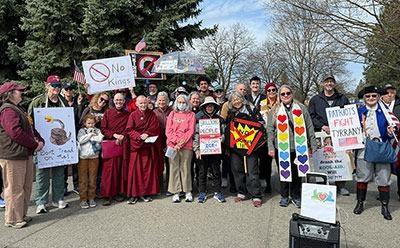
Top: Gen Heywood, center right with stole of hearts, gathered an interfaith vigil with Faith Leaders and Leaders of Conscience before the March No Kings rally in Spokane.Bottom: Gen Heywood, right, lead a workshop on Faithful Advocacy with Karen Stromgren of Muslims for Community Action and Support for the Eastern Washington Legislative Conference. |
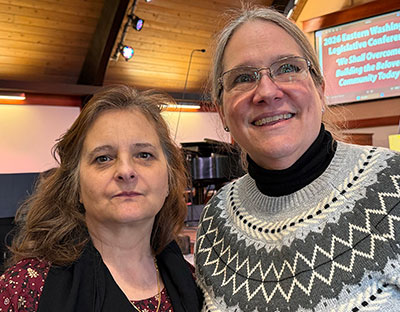
They co-led a workshop on “Knowing the Culture of Your Community,” exploring how churches can be “vibrant, welcoming centers of connection, service and hope within their communities.”
They discussed how their churches are centers for gathering, worshiping, learning, caring and collaborating to meet the needs of their communities. While their ministries differ, they remain in covenant through the Pacific Northwest Conference.
Gen, who grew up in Durham, Me., felt called to ministry at the age of 11. In 1983, she earned a bachelor’s degree in German and music therapy from Emmanuel College in Boston. She worked as a music therapist while studying at Andover Newton Theological School, where she earned a master of divinity in 1989. She served churches in Maine moved to California, married, had two children and served churches in California, before coming Veradale UCC in 2014.
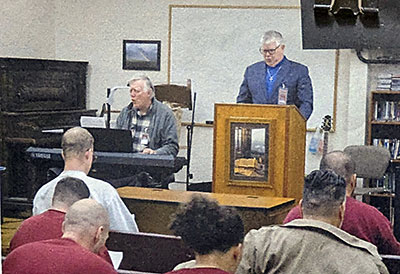
Warren was the church’s janitor, when in 2008 God called him into ministry. He was licensed in 2014 and ordained in 2024, after he retired from the Department of Corrections.
The demographics of their churches and communities shape their ministries as both partner to meet local needs. They agreed there is no one formula for churches, just an invitation to be faithful where they are.
Veradale UCC began in 1910 as the only church in a small farm town that became a suburb east of Spokane and is now the City of Spokane Valley. In the early years, they picked up neighbors of many different denominations with a horse drawn cart.
“The church was founded with a spirit of inclusivity that has been with it through the years,” said Gen.
Members listened to low-income parents of children in the school across the street and developed a lay-led program to provide healthy snacks to children after school.
One member also developed a blessing box to offer scarves, mittens, toothpaste, toothbrushes, sunscreen and seasonal items.
With the Baha’i community, some members created birthday cake kits for the ecumenical food bank.
The church had a harvest festival until there were not enough members to prepare it. They had a community garden, until others developed community gardens. Now they may use the space for solar panels.
They partner with other Spokane Valley congregations through Partners Inland Northwest to provide a food bank, clothing bank and other services.
“We give witness to what it means to be a church that welcomes all,” Gen said.
Displaying Black Lives Matter and LGBTQ flags, the church became the target of hate crimes and has worked to bring justice and challenge white supremacy.
Members partner with others to work for justice and inclusiveness. Inspired by the Poor People’s Campaign challenge to racism, poverty, militarism and climate change, they formed Faith Leaders and Leaders of Conscience (FLLC), a coalition whose members show up at city council and school board meetings and write letters to the editor as an interfaith witness to challenge Christian nationalism and bigotry.
“We go out to stand with people who don’t have to come to the church,” said Gen, who wears a clergy collar when she does to city council.
She showed slides of an FLLC Earth Day vigil with Tibetan nuns from Newport, the retired chair of the Spokane Tribe and people of faith joining the rabbi in a Jewish dance at the Episcopal cathedral.
“We connect with NAACP Spokane, Spokane PRIDE, No Kings rallies and 509 Be the Change rallies to support people doing good,” Gen said.
Forks First Congregational is a small church on the Olympic Peninsula that has grown in recent years by engaging with the community.
|
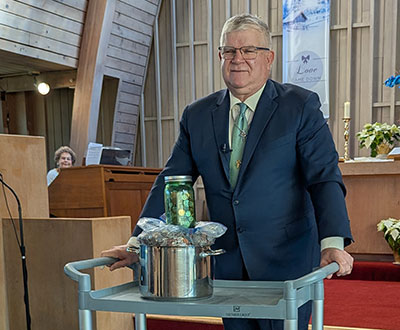
Warren Johnson prays over Super Bowl Sunday offering, top, and volunteers at Olympic Corrections Center, bottom. |
The church started about 1900 in a schoolhouse. The first pastor came and built the first church in a mile outside the town. In 1922, they used tractors and trucks to pull the church on skids to the middle of town. In 1955, the members raised $70,000 to build a new building with a big fellowship hall in the middle of town that is a community center.
Warren, who first attended in 1981 at Christian and Easter to watch his children’s programs.
He became more involved over the years and was moderator in 1997, when the pastor was forced to leave. About that time, he felt “the Lord calling me to put him first,” which Warren did for 11 years. In 2008, the church was down to $20,000 and six members, on the verge of closing.
“The Lord came to me and said, ‘Are you ready to lead my people?’ I said OK,” said Warren, who began studies to be licensed and then ordained.
“It’s been quite the journey. With people who come to church, I teach them the history of the church,” he said. “It’s important for us to know where we come from, so we know where we’re going and how we fit in our community.”
He suggests that churches ask how they are meeting needs of their community and volunteer.
“By doing that we bring people back in the church,” said Warren, who is also president of the local food bank.
He suggests opening the church building for meetings of the historical society, business and professional association, men’s groups, senior meals and other organizations.
People become used to coming to the building, and then some may start attending church.
Forks, which began as a logging community, started drawing people from all over the country and the world, liberal and conservative. Some have started coming to church.
“Our doors are open. People come in off the street when it’s raining cats and dogs,” Warren said. “We offer a warm bowl of soup and food.
Some church people at first thought it was crazy to invite strangers who were dirty. Warren reminded that Jesus tests the church to see how they treat people coming through the door.
“We covenant with God and Jesus, who are the head of our church,” he said. “We set our differences aside no matter what they are, so we are working for the betterment of the whole church and go out into the world.
People walking through the front door, which is open, see the church life, ecumenical Bible study classes, community meals, senior meals and ways the church can meet their needs, he said.
Community members attending church functions expect to be asked to give to support efforts. In addition, Warren volunteers with local organizations, so people know him in the community.
When the food bank was down to $38,000, he and the executive director went to the community and raised $240,000 to feed hungry people.
On Super Bowl Sunday, he passed a soup pot and collected more than $1,800 during worship.
This year, Forks First Congregational Church’s 40 members gave $7,500 to the food bank. Six years ago, they gave $5,000 to the hospital foundation for a new mammogram machine. Another time they raised $10,000 with other churches towards a bus for the long-term care center.
The church prepares a Senior Luncheon on the second Wednesdays of the month. Attendees put donations in a jar. Children from the school across the street and home schools sometimes help serve the food.
In the years since 2008, when plaster was falling off the wall, there were single-pane windows and they had diesel furnaces, the church invested $400,000 for heat pump furnaces, new double-pane windows, other building improvements, Wi-Fi and a good speaker system. So the church is a comfortable place for the community events and means and has the tech to host conferences.
“We preach the word of God to the people of God, so they serve as a community church. I’m the spiritual shepherd and lead by example,” Warren said, noting that the members make things happen.”
“We are two different churches with different ways of doing things. Together we work for God’s Kingdom, meeting the needs of our people, our cultures and our communities,” Warren commented in concluding his workshop presentation.
Workshop participants then shared how their churches are reaching out to their communities and building partnerships to meet local needs.
For information, email genheywood@gmail.com or wrjfork@hotmail.com.
Pacific Northwest Conference United Church of Christ News © April 2026
Share this article on your favorite social media 